Application map
One Fibers business, different qualification contexts
Application labels help frame a brief, but they do not establish product suitability. Apparel, home textile, hygiene and mobility programs ask different questions about linear density, processing, mechanical behavior, color, route evidence and the converted structure.
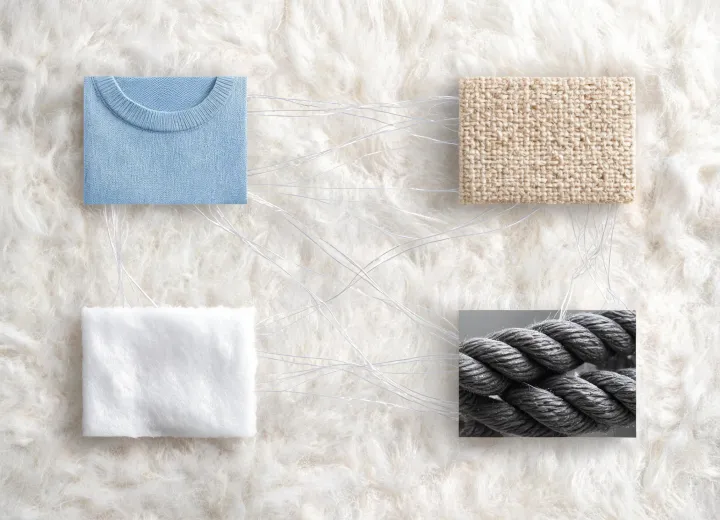
Review by application context
The tabs are organized by conversion and end-use needs rather than geography. They do not represent sales territories, customer lists or manufacturing locations.
Apparel and home-textile conversion
Staple fibers and filament yarns may enter spinning, texturing, weaving, knitting, dyeing and finishing. A responsible brief records fiber or yarn form, denier/dtex, filament count or staple geometry, color route, hand and dimensional targets, plus the converted-fabric test plan.
- Confirm whether performance is measured on the supplied yarn or finished fabric.
- Define shade, dye lot and colorfastness method at the relevant conversion stage.
- Compare recycled or bio-based pathways separately from handle and durability.
- Do not infer a universal GSM or width from a fiber/yarn product.
Hygiene conversion context
Fiber form, bonding process, basis-weight design and surface requirements interact. The material brief should identify the layer function and converter process before asking for filtration, softness, fluid handling or mechanical behavior.
- Keep fiber specifications distinct from finished nonwoven performance.
- Name the target layer, conversion method and applicable test protocol.
- Confirm chemical and regulatory documentation for the intended market.
- A hygiene application does not add a second site product category.
High-tenacity and cord context
Technical yarns and cords require precise construction and method-linked mechanical targets. Product behavior after twisting, weaving, coating or assembly cannot be predicted from a generic “high performance” label.
- Record dtex, filament configuration, twist, tenacity and elongation method.
- Specify conditioning and any thermal or fatigue sequence.
- Validate the converted construction and end-use assembly.
- No safety performance claim is made without the named product and test evidence.
Map your application to a testable brief
State the vertical, layer or component, supplied form, conversion sequence, performance method, claim route, quantity and timing. Avoid substituting application fame or group scale for product evidence.